
Zhantao Chen, an Assistant Professor in Mechanical Engineering and a TMI-affiliate, has published an article on an AI tool in Nature Machine Intelligence. The article used AI to help researchers in ways that would assist in experimental tasks that are often labor-intensive and tiresome.
Chen and his collaborators developed an AI system that autonomously aligns synchrotron X-ray scattering experiments, a step that has typically required human expertise to accomplish. Using existing large language models (LLMs), they created an "AI X-ray scientist" that was able to correctly identify and correct alignment issues on an operational synchrotron. The "scientist" also responded to unexpected conditions, "demonstrating adaptive problem-solving and readiness for addressing practical experimental situations."
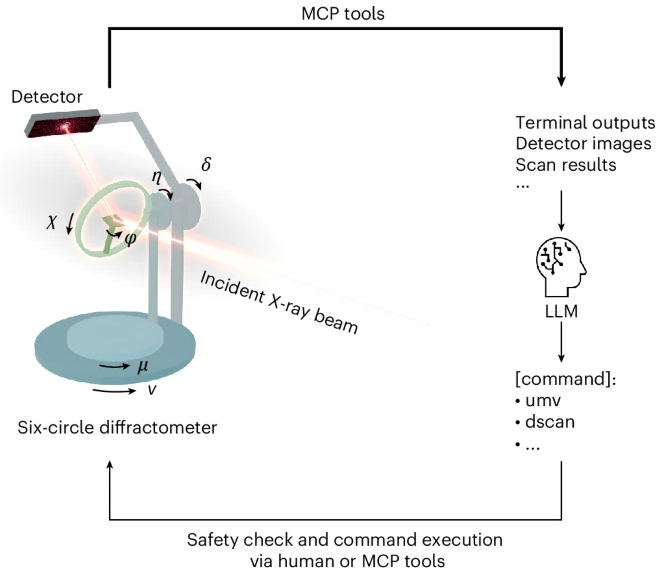
While the project started off as a way to avoid the tedious tasks of aligning samples for single-crystal synchrotron X-ray experiments, Chen said during an interview with Phys.org about the article, it turned into a bigger question of whether or not AI could "reason through and perform experimental tasks much like a human scientist at a real-world synchrotron beamline." While Chen's article specifically studied sample alignment on synchrotrons, his work demonstrates how AI could be used to assist in experimental tasks more broadly.
You can read more of Chen's interview with Phys.org at "AI agent helps prepare synchrotron X-ray experimental measurements, paving the way for autonomous operation." Read more about the system and "scientist" in "An agentic artificially intelligent X-ray scientist" at Nature Machine Intelligence.
