
Materials Science and Engineering graduate student Tianrui (Terry) Zheng, under the supervision of Dr. Guihua Yu has published research in Advanced Materials introducing a biphasic electrolyte architecture that combines the strengths of water-based (aqueous) and organic-based electrolytes for long-duration, high-rate zinc metal batteries.
Aqueous electrolytes are promising for grid-scale energy storage due to inherent safety, lower cost and less reliance on critical minerals. However, their electrochemical stability is intrinsically limited by the water splitting reactions. Organic electrolytes, on the other hand, offer much greater electrochemical stability but suffer from slower ion transport.
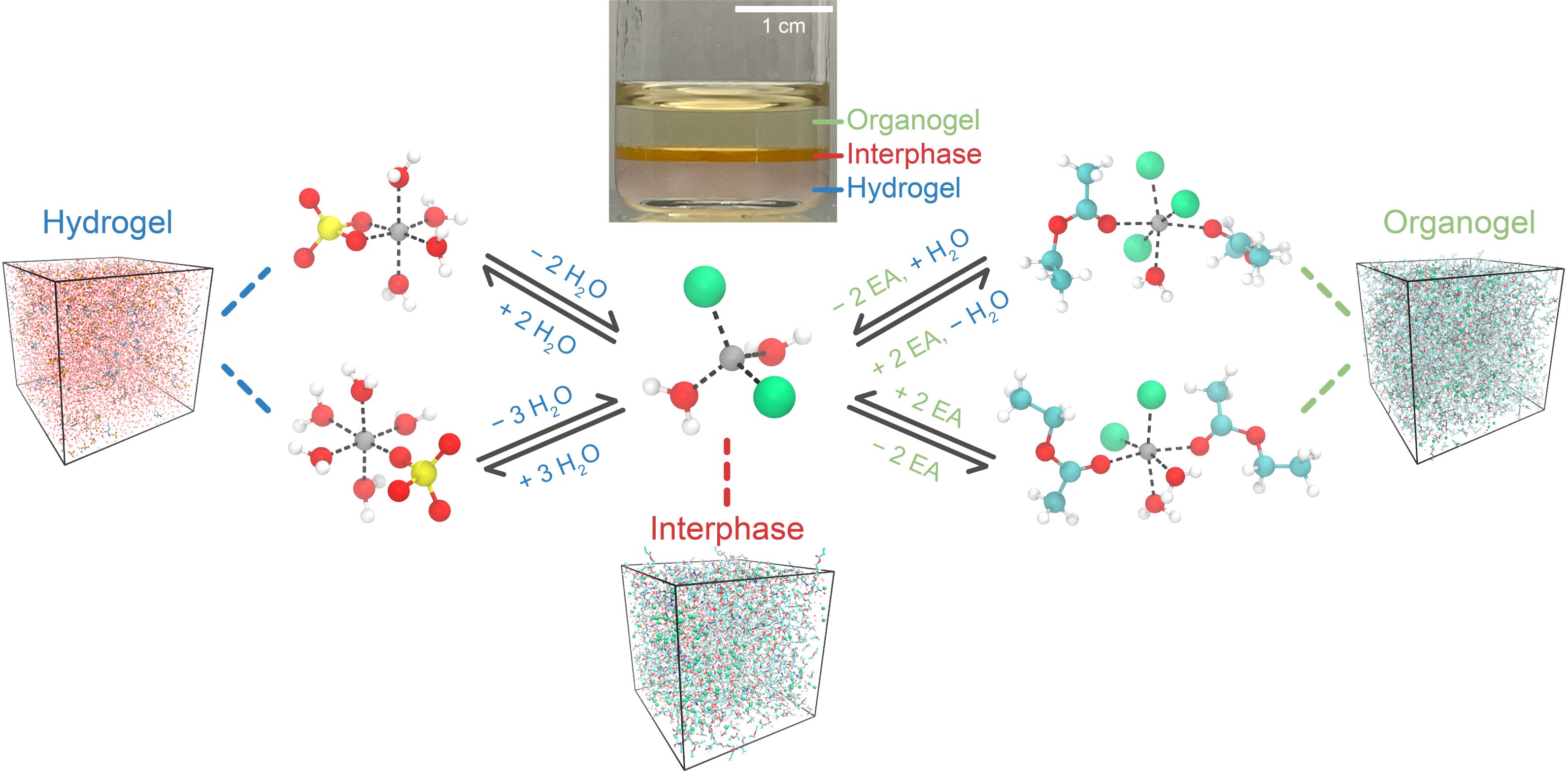
The newly developed biphasic gel electrolyte integrates the two electrolyte systems into one. A newly discovered amphiphilicity-induced interphase (where a molecule has both hydrophilic and lipophilic parts) bridges the aqueous and organic phases, enabling smooth ion transport across the interface. Meanwhile, the compartmentalized configuration decouples the electrochemical environments of the cathode and anode, allowing each side to operate under its optimal and stable conditions. Overall, this work establishes a new strategy for electrolyte design that overcomes the conventional trade-off between ionic conductivity and electrochemical stability, potentially accelerating the development of safe, low-cost, and high-performance grid-scale energy storage technologies.
Read more of the article, "A Hydro–Organo Biphasic Gel Electrolyte for Decoupled Interfacial Stability and Fast Ion Transport in Zinc Metal Batteries," at Advanced Materials.
