
Two alumni of the Materials Science & Engineering program, from TMI director Jamie Warner's group, have published articles that introduce new techniques for analyzing materials using electron microscopy. Kevin Matthews's paper used cryogenics and ion beam milling to study full liquid-electrolyte batteries, while Matthew Coupin used a combination of nanoscale 2D electron energy loss spectroscopy (EELS) and 3D scanning transmission electron microscopy (STEM) to better study polymer desalination membranes.
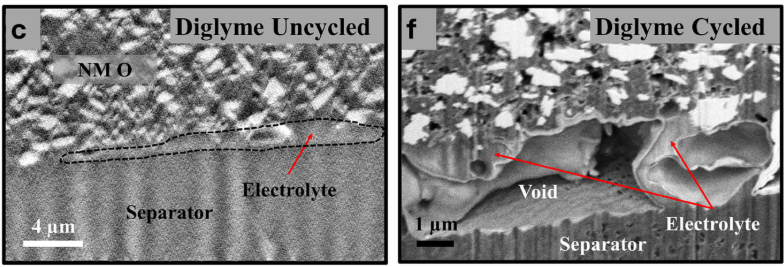
Matthews, in collaboration with C. Buddie Mullins and his graduate student, Rinish Vaidyula, plunged battery cells into liquid nitrogen to freeze the liquid electrolytes. Once removed from their casings, the cells were cut with a gallium ion beam to obtain a cross-section of the three layers: the cathode, separator, and anode. The team was then able to study the effects the electrolytes had on the cell's microstructure after cycling. They found that the stability of sodium metal batteries is not determined by one side of the battery or the other, but rather on how both sides work together and affect each other at their contact surfaces.
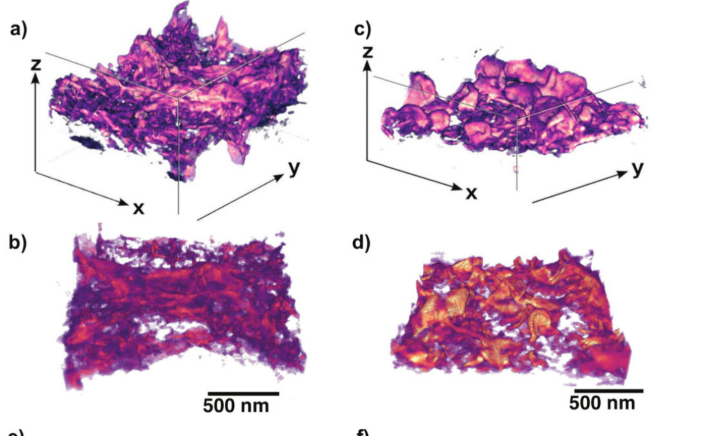
Coupin, in collaboration with Manish Kumar and his graduate student Chenhao Yao, as well as Dr. Jeffrey McCutcheon from the University of Conneticut and his graduate student Mert Can Hacifazlioglu, used a combination of 2D EELS and and High-Angle Annular Dark-Field STEM to produce 3d density reconstructions of commercial seawater and brackish water reverse osmosis membranes and compared them to thin uniform printed membranes. The team was able to find clear nanoscale differences between the commercial membranes and the specially made, uniform ones, which helps to explain why the membranes performed differently when separating water from the salt.
To read more about Kevin Matthew's work, see their article "Revealing Cycling-Induced Evolution of Intact Sodium Metal Battery Interfaces Using Cryo-Focused Ion Beam Cross-Sectioning and Electron Microscopy" in Small.
To read more about Matthew Coupin's work, see their article "Quantitative Nanoscale Structure Determination in Polymer Desalination Membranes by Correlated Electron Tomography and Spectroscopy" in ACS Nano.
